Holistic Learning approach
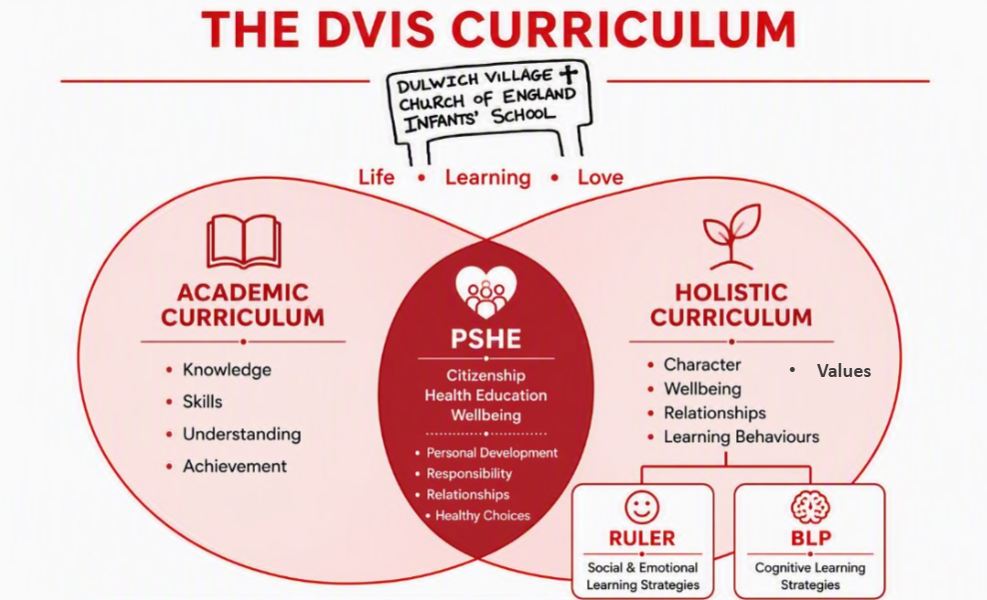
We want all children to flourish with God in life, learning and love. It is therefore important to capture our approach to key aspects of early childhood education in school. These key elements of a child’s life include their emotions, relationships and their approach to learning. Without a solid basis to spring from, our experience and evidence-based practice shows that children can’t and won’t learn, therefore it is vital that we focus on the children’s emotions, their relationships with themselves as well as with others and their approach to learning i.e. how they learn.
To find out a more about how we do this please read this document:
Building Learning Power
Building Learning Power is an approach to learning created by Guy Claxton as a way of learning about learning, also known as metacognition, and focuses on the four learning powers which are resourcefulness, reciprocity, reflectiveness and resilience. Research into how the mind works shows that we are all capable of becoming better learners and by teaching the children about the way they learn, they can then become better learners, both inside and outside of the classroom. It teaches children how to persevere, reflect and become more resilient. Below is more information on three of the learning powers we have been focusing on across the school.
-
We will be focusing on one learning power a term and this term we are finding out more about resourcefulness. We have chosen Miss Curious as a symbol for this!
Questioning - Asking questions of yourself and others. Being curious and playful with ideas – delving beneath the surface of things.
Making Links - Seeing connections between disparate events and experiences – building patterns – weaving a web of understanding.
Imagining - Using your imagination and intuition to put yourself through the new experiences or to explore possibilities. Wondering What if…?
Reasoning - Calling up your logical and rational skills to work things out methodically and rigorously; constructing good arguments, and spotting the flaws in others'.
Capitalising - Drawing on the full range of resources from the wider world – other people, books, the Internet, past experience, future opportunities...
-
Another learning power we use is Resilience. We have chosen Mr Bump as a symbol for this!
Mr Bump has powers that he uses for when he gets knocked over and needs to show resilience. The powers Mr Bump has for resilience include:
Absorption - Being able to lose yourself in learning — becoming absorbed in what you are doing; rapt and attentive, in a state of ‘flow’.
Managing Distractions - Recognising and reducing distractions; knowing when to walk away and refresh yourself. Creating your own best environment for learning.
Noticing - Perceiving subtle nuances, patterns and details in experience.
Perseverance - Keeping going on even in the face of difficulties, channelling the energy of frustration productively. Knowing what a slow and uncertain process learning often is.
We will keep you updated on how and when we discuss more aspects of the learning powers on this webpage and our newsletters.
-
We have chosen Miss Inventor as the symbol for the learning power of reflectiveness.
Miss Inventor has powers that means she is ready, willing and able to become more strategic (clever/planned/thoughtful/forward thinking) about learning.
The powers Miss Inventor has to be reflective include:
Planning – making plans for what might be needed to do the activity, making actions step by step for the activity, plan the time it might need.
Revising – being willing to revise and change plans, reflect and work out if the plan is what you wanted or hoped.
Distilling – looking at past learning and experiences and using those to help with learning.
Meta-Learning – understanding learning and yourself as a learner.
What does it mean to be meta?
In the world of gaming, meta is used in two ways. Meta can be used as an acronym for “most effective tactics available,” and calling something “meta” means that it's an effective way to achieve the goal of the game, whether it's to beat other players or beat the game itself
RULER
At DVIS we use the RULER approach to emotional intelligence and literacy. Through this approach we encourage the children to recognise, name and work with their emotions, whatever they may be. We build up a bank of vocabulary in relation to emotions and a tool box of ideas to work through that emotion. We teach the children that emotions can either be pleasant or unpleasant, high energy or low energy and we never refer to emotions as being negative or positive as all emotions are useful. There are four tools that we focus on during our lessons which are: the mood meter, the charter, the meta-moment and the blueprint. For more visit RULER Approach.
Recognising emotions in oneself and others
Understanding the causes and consequences of emotions
Labelling emotions with a nuanced vocabulary
Expressing emotions in accordance with cultural norms & social context
Regulating emotions with helpful strategies
PSHE
(Personal, Social, Health and Economic Education)
Our bespoke PSHE curriculum supports our work on RULER. We use a programme created by the Islington Trust called You, Me and PSHE which looks at topics such as "Who Keeps Us Safe?", "What keeps me healthy", "How to save money" and "feelings". Alongside this, we are in contact with other charities and organisations such as Healthy Schools London, NSPCC and the PSHE Association to inform our PSHE Curriculum. We also use a scheme called R-Time in Reception which helps children to build and enhance relationships.
Our PSHE curriculum supports children to develop the knowledge, skills and understanding needed to build positive relationships, make healthy choices and look after their wellbeing. Relationships and Health Education (RHE) is interwoven throughout the curriculum, supporting and enhancing children’s PSHE learning.